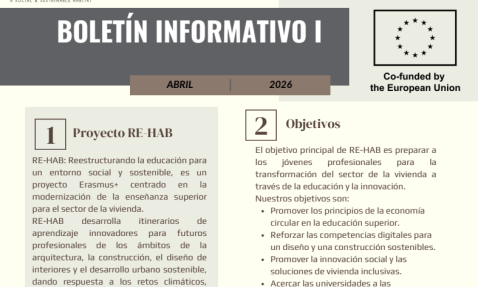
RE-HAB advances with its European training programme, comprising five modules on sustainability, digitalisation and inclusion
The second newsletter from the European RE-HAB project outlines progress in the development of a joint curriculum worth 15 ECTS credits and the results of its evaluation, which involved 41 participants from five European countries.
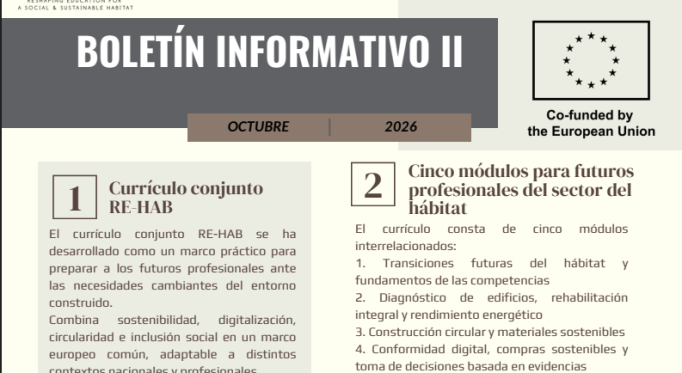
The European RE-HAB project (Reshaping Education for a Social & Sustainable Habitat), in which CETEM is participating, has published its second newsletter, dated October 2026. This latest edition details the progress made in designing the educational programme and the results of its evaluation by students, teachers, trainers and professionals in the sector.
Having identified the skills required to tackle the challenges of the ecological and digital transition, the project is now moving towards the development of educational resources that will enable this knowledge to be incorporated into the training of future professionals in the built environment.
One of the key findings highlighted in the bulletin is the establishment of a joint European curriculum, structured around five training modules and worth 15 ECTS credits.
The programme covers topics such as future changes to the built environment, the assessment and energy-efficient refurbishment of buildings, circular construction and sustainable materials, digitalisation and responsible procurement, as well as collaboration and inclusive design.
Its approach combines technical, digital and social skills through a progressive pathway that can be adapted to different educational and professional contexts.
Furthermore, the curriculum adopts a practical approach, based on real-world challenges relating to the refurbishment and improvement of housing, with the involvement of universities, public authorities, businesses and other social stakeholders.
The programme has been evaluated by 41 participants from Germany, Spain, Portugal, Poland and Cyprus, with positive results.
The relevance of the learning outcomes to the sector received an average rating of 4.34 out of 5, whilst their suitability for educational and training programmes was rated at 4.44 out of 5.
Furthermore, 85.4 per cent of those surveyed rated both aspects with scores of 4 or 5.
The evaluation also helped to identify opportunities for improvement, particularly in the practical application of circular construction, the strengthening of digital skills, and the incorporation of case studies, exercises and real-world projects.
The newsletter also includes the results of the consortium’s second transnational meeting, held on 23 and 24 September in Coimbra (Portugal).
During this meeting, the partners discussed the transition from curriculum design to the development of training materials, which will include handbooks, presentations, videos, practical exercises and other open educational resources.
They also made progress on finalising the micro-credential system and the future digital learning platform.
Through these initiatives, RE-HAB continues to develop educational tools aimed at improving the training of future professionals in the housing sector, aligning higher education with the environmental, technological and social needs of the industry.
The second newsletter summarises the key progress and results of this new phase of the project.
More information: https://www.re-hab.eu/

Funded by the European Union. The opinions and views expressed are solely those of the authors and do not necessarily reflect those of the European Union or the European Education and Culture Executive Agency (EACEA). Neither the European Union nor the EACEA can be held responsible for them.
Compartir post:
Noticias relacionadas
The third FITT-NESS newsletter showcases the latest developments in driving innovation in furniture and the home
INSET project webinar: turning knowledge into action for industrial symbiosis