RE-HAB presents its initial steps towards transforming the training of future professionals in the housing sector
The first newsletter from the European RE-HAB project outlines its objectives, the main activities planned and the initial results of an initiative aimed at promoting digital, sustainable and social skills in higher education.
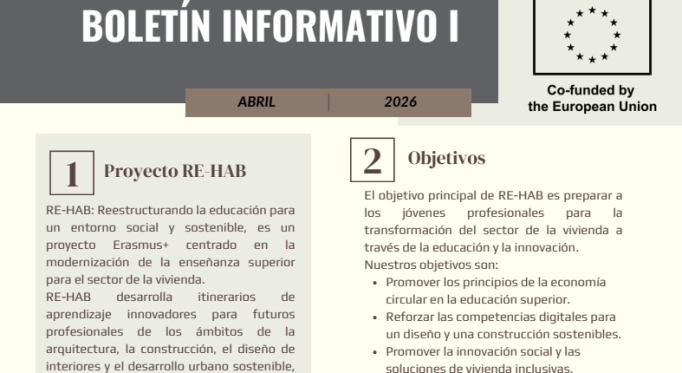
The European RE-HAB project (Reshaping Education for a Social & Sustainable Habitat), in which the Murcia Region Furniture and Wood Technology Centre (CETEM) is participating, has published its first newsletter, dated April 2026. The publication outlines the areas of focus for this Erasmus+ initiative, which aims to modernise the training of future professionals in the housing sector.
RE-HAB aims to respond to the changes taking place in fields such as architecture, construction, interior design and sustainable urban development. To this end, it promotes the incorporation of skills relating to the circular economy, digitalisation and social innovation into higher education programmes.
One of the project’s main objectives is to align university education more closely with the real needs of the labour market, providing students with the tools to tackle environmental, technological and social challenges.
Key activities planned include the development of a European framework of competences, the creation of a joint training programme featuring micro-credentials, and the establishment of a digital platform offering open educational resources.
These tools will enable us to offer more flexible learning opportunities and facilitate the acquisition of knowledge that can be applied to real-life situations within the sector.
The newsletter also sets out the progress made during the first few months of implementation.
Following the kick-off meeting held in Germany in January 2026, the partners began the research and coordination activities required to develop the project’s main outputs.
One of the key milestones is the production of the first transnational synthesis report, which analyses the needs of the housing sector in Germany, Spain, Portugal, Poland and Cyprus.
This study identifies common trends and country-specific challenges, whilst also highlighting the emergence of a new professional profile: the digital-ecological-social integrator.
This role combines technical expertise with skills in sustainability, digital tools and community-centred approaches.
The results of the analysis will serve as the basis for developing the competence framework and educational resources that will form part of the future RE-HAB training programme.
Through its involvement in this initiative, CETEM helps to link innovation and the needs of the housing sector with the development of new training opportunities at European level.
RE-HAB’s first newsletter provides a more detailed insight into the project’s objectives, activities and initial progress.
More information about RE-HAB: https://www.re-hab.eu/

Funded by the European Union. The opinions and views expressed are solely those of the authors and do not necessarily reflect those of the European Union or the European Education and Culture Executive Agency (EACEA). Neither the European Union nor the EACEA can be held responsible for them.
Compartir post:
Noticias relacionadas
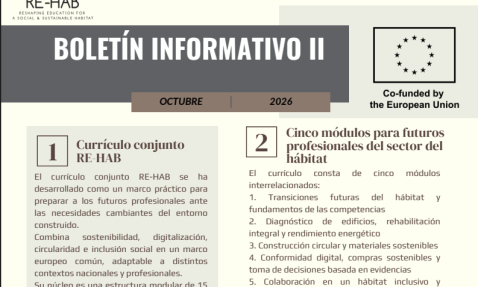
RE-HAB advances with its European training programme, comprising five modules on sustainability, digitalisation and inclusion
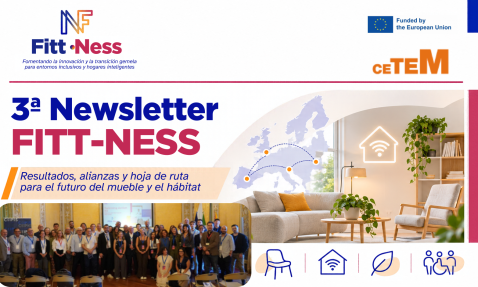
The third FITT-NESS newsletter showcases the latest developments in driving innovation in furniture and the home